"We Lived as Do Spouses:" AIDS, Neoliberalism, and Family-Based Apartment Succession Rights in 1980s New York City
Abstract
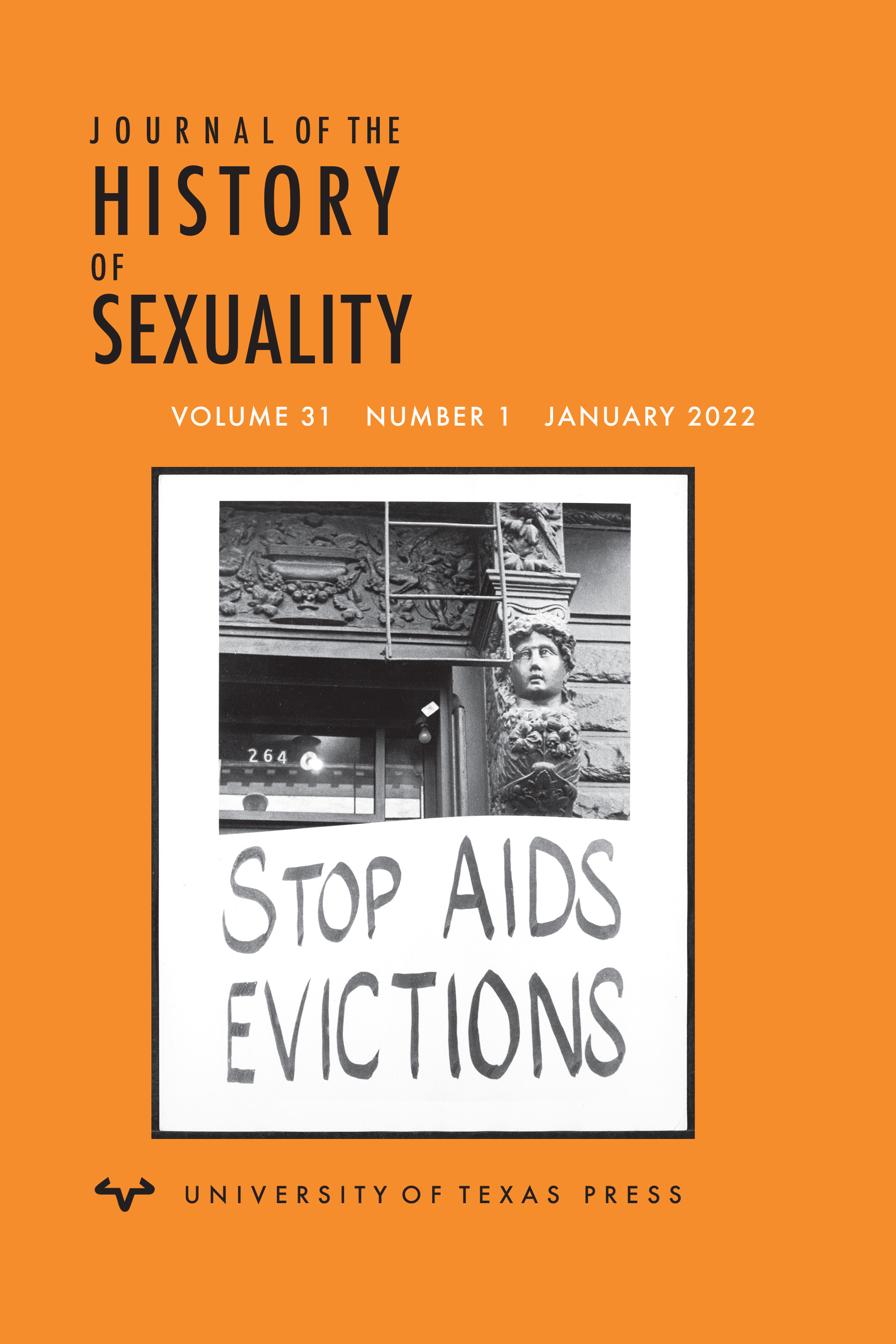
Real estate is crucial to understanding the story of AIDS in 1980s New York City. Although LGBTQ (lesbian, gay, bisexual, transgender, and queer) people’s vulnerability to eviction predated the AIDS epidemic, AIDS-related deaths brought questions of succession rights over rent-regulated apartments to the forefront of LGBTQ rights efforts. And, with it, questions of who counted as “family.” As gay men died of AIDS-related complications, their survivors were often threatened with eviction by landlords who did not consider them family members of the deceased tenants as defined by blood, marriage, or adoption. Landlords were incentivized as they could profit by evicting unrelated “roommates” or by forcing them to sign new leases, either of which generated higher rents. This article examines the strategies AIDS housing activists and gay rights litigators undertook in persuading the courts that some same-sex couples were, indeed, families for the purpose of succession rights. Through archival research of court documents, private letters, and city reports, I delineate the possibilities and constraints of a privacy-based political approach to apartment succession rights. The most successful legal challenge was 1989’s Braschi v. Stahl Associates Company, in which the plaintiff’s attorneys petitioned the New York State Court of Appeals to widen the definition of family to accommodate the new situation of AIDS-related homelessness. I argue that Braschi actualized a central tenet of neoliberalism: the regression to the privatized nuclear family as a primary unit of economic and social interdependence. This legal endeavor foreshadowed the transformation of LGBTQ politics into an ethos of homonormativity—a development that conscripted the private housing market as one of the dominant means of addressing AIDS-related homelessness and prefigured more recent calls for same-sex marriage.
References
Ball, Carlos A. From the Closet to the Courtroom: Five LGBT Rights Lawsuits That Have Changed Our Nation. Boston, MA: Beacon Press, 2010.
Burt, Martha. “Causes of the Growth of Homelessness During the 1980s.” Housing Policy Debate 2 (1991): 3.
Canaday, Margot. The Straight State: Sexuality and Citizenship in Twentieth-Century America. Princeton, NJ: Princeton University Press, 2011.
Chauncey, George. Why Marriage? The History Shaping Today’s Debate Over Gay Equality. New York: Basic Books, 2004.
Cott, Nancy F. Public Vows: A History of Marriage and the Nation. Cambridge, MA: Harvard University Press, 2000.
Duggan, Lisa. The Twilight of Equality: Neoliberalism, Cultural Politics, and the Attack on Democracy. Boston: Beacon Press, 2003.
Eisenberg, Ariel. “‘A Shelter Can Tip the Scales Sometimes’: Disinvestment, Gentrification, and Homelessness in 1980s New York City.” Journal of Urban History 43, no. 6 (Nov. 2017): 915-31.
Elias, Norbert. The Civilizing Process: Sociogenetic and Psychogenetic Investigations. Translated by Edmund Jephcott. Malden, MA: Blackwell, 1994.
Geary, Adam M. Anti-Black Racism and the AIDS Epidemic: State Intimacies. New York: Palgrave Macmillan, 2014.
Gould, Deborah B. Moving Politics: Emotion and ACT UP’s Fight Against AIDS. Chicago: University of Chicago Press, 2009.
Hanhardt, Christina B., “Broken Windows at Blue’s: A Queer History of Policing.” In The Planetary Crisis of Policing: Why the Policing Crisis Led to Black Lives Matter, edited by Jordan T. Camp and Christina Heatherton. Brooklyn, NY: Verso Books, 2016.
Harris, Cheryl I., “Whiteness as Property,” Harvard Law Review 106, no. 8 (Jun. 1993): 1707-91.
Hobson, Emily K. Lavender and Red: Liberation and Solidarity in the Gay and Lesbian Left. Oakland: University of California Press, 2016.
Hooper, Kim. Reckoning with Homelessness. Ithaca, NY: Cornell University Press, 2003.
Howard, Clayton. The Closet and the Cul-de-Sac: The Politics of Sexual Privacy in Northern California. Philadelphia, PA: University of Pennsylvania Press, 2019.
Kohler-Hausmann, Julilly. “Welfare Crises, Penal Solutions, and the Origins of the ‘Welfare Queen’.” Journal of Urban History 4, no. 5 (Sep. 2015): 766.
Leonard, Arthur S. “Lesbian and Gay Families and the Law: A Progress Report.” Fordham Urban Law Journal 21, no. 4 (1994): 927-72.
Leonard, Arthur S. Sexuality and the Law: An Encyclopedia of Major Legal Cases. New York: Garland Publishing, 1993.
Murray, Heather. Not in This Family: Gays and the Meaning of Kinship in Postwar North America. Philadelphia, PA: University of Pennsylvania Press, 2010.
Nardi, Peter M., “Friends, Lovers, and Families: The Impact of AIDS on Gay and Lesbian Relationships.” In In Changing Times: Gay Men and Lesbians Encounter HIV/AIDS, edited by Martin P. Levine, Peter M. Nardi, and John H. Gagnon, 55-82. Chicago: University of Chicago Press, 1997.
Pleck, Elizabeth H. Not Just Roommates: Cohabitation after the Sexual Revolution. Chicago, IL: University of Chicago Press, 2012.
Rich, Adrienne. “Compulsory Heterosexuality and Lesbian Existence.” Signs: Journal of Women in Culture and Society 5, no. 4 (1980): 631-60.
Rubenstein, William B. “We Are Family: A Reflection on the Search for Legal Recognition of Lesbian and Gay Relationships.” Journal of Law & Politics vol. VIII (1991): 89-105.
Rivers, Daniel Winunwe. Radical Relations: Lesbian Mothers, Gay Fathers, and Their Children in the United States since World War II. Chapel Hill, NC: University of North Carolina Press, 2013.
Schulman, Sarah M. The Gentrification of the Mind: Witness to a Lost Imagination. Berkeley, CA: University of California Press, 2013.
Shah, Nayan, “Queer of Color Estrangement and Belonging.” In The Routledge History of Queer America, edited by Don Romesburg. New York: Routledge, 2018.
Shepard, Benjamin. Queer Political Performance and Protest. New York: Routledge, 2010.
Sudhir Venkatesh. American Project: The Rise and Fall of a Modern Ghetto. Cambridge, MA: Harvard University Press, 2000.
Vider, Stephen. “‘The Ultimate Extension of Gay Community’: Communal Living and Gay Liberation in the 1970s.” Gender & History 27 no. 3 (Nov. 2015): 865-81.
Wallace, Roderick et al. “Deindustrialization, inner-city decay, and the hierarchical diffusion of AIDS in the USA: How neoliberal and cold war policies magnified the ecological niche for emerging infections and created a national security crisis.” Environment and planning A 31 (Jan. 1999): 113-39.
Weston, Kath. Families We Choose: Lesbians, Gays, Kinship. New York: Columbia University Press, 1991.